My New Year’s resolution was to read 50 books in 2026. As the weeks press on, I am faced with my devastatingly disappointing second semester where my lofty goal is feeling loftier. I am awfully proud of the strong start I’ve had in January, starting it off with “The Secret History” by Donna Tartt, hoping to end it with R.F Kuang’s “Babel,” and gobbling up Kahled Hosseini’s triumphant first work somewhere in between.
“The Kite Runner,” which is included in the 11th grade English curriculum at Strath Haven, follows a wealthy boy named Amir growing up among the bustling Sunday markets and colorful kite fights of the thriving city of Kabul in Afghanistan. Amir lives in a mansion with his hard-to-please father and their two servants, a crippled man named Ali and his son, Hassan.
Amir is of the favored Pashtun race, while Hassan faces discrimination for being a Hazara. The historic socioeconomic clash between these two groups in Afghanistan is a central part of Amir and Hassan’s complex relationship.
Hassan and Amir are like brothers— they do everything together, including flying and running kites in the annual Kabul kite fighting contest. Amir wins the contest one year, and Hassan dutifully goes to retrieve the last kite Amir defeated.
Hassan runs into three bullies who threaten him, hoping to steal the kite. When Hassan in his unwavering loyalty to Amir will not give it up, he suffers a brutal rape that Amir witnesses and is haunted by for the rest of his life.
Amir and his father eventually flee to America once Afghanistan falls into chaos, but Amir returns to dangerous Afghanistan years later hoping to save Hassan’s son and finally make things right.
Amir and Hassan’s relationship is the pulsing heart of the novel. At times the descriptions of their childhood blossoms a sweetness in my stomach, other times it leaves a bad taste in my mouth. One realizes throughout the book that their relationship cannot be considered a simple friendship.
Amir is constantly upset with his father’s approval of Hassan. Even though he is poor, and of the undesirable Hazara race, and Hassan is in constant submission to Amir, he’d rather be brutally attacked than give away Amir’s kite.
While my initial expectation was a warm and fuzzy story about friendship, the book goes deeper than that, exploring the complex and dark intertwinement of the two boys: Hassan tied to Amir through submission and loyalty, and Amir to Hassan through guilt and jealousy.
This novel also utilizes the full circle moment in the least cliché way possible; it’s done so well that I could believe that Hosseini is the inventor of the whole concept. When Amir learns of Hassan’s son Sohrab’s desperate situation in war-torn Afghanistan becomes an opportunity to right a generational wrong.
I was appalled at Amir’s decision to watch Hassan’s rape as a child and then push him away as a friend because of it, but Amir’s bravery when it came to protecting Hassan’s son offered immense satisfaction.
While it’s up to interpretation if Amir’s motivation was to alleviate himself of his own crushing shame or if he truly wanted to help Sohrab, the ending was so hopeful and a beautiful breakage of the generational pain and sorrow Hassan’s family has had to endure.
The final scene, where Sohrab smiles for the first time in America while running a kite, shows us that things can and will get better. For Sohrab, an orphaned and abused boy, for Amir, a shame stricken man, and for Afghanistan, a tragically tarnished nation.
While the book broaches complex push and pull themes of guilt and redemption as well as realistic descriptions of a violent Afghanistan, it remains utterly accessible. Hosseini’s prose is simple and straightforward, it lets the story do the talking. The sentences are under-embellished, Hosseini chose every word with the utmost care.
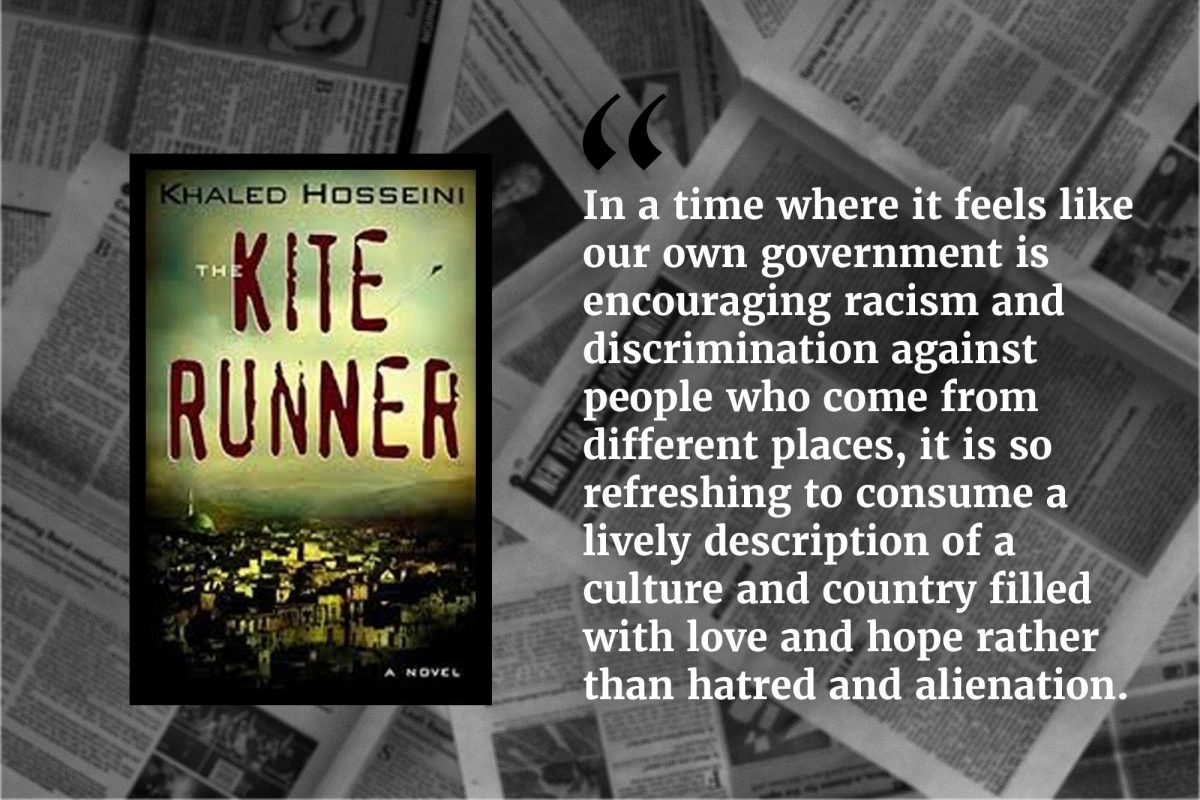
Hosseini’s love for his country is so clear through his writing. In a time where it feels like our own government is encouraging racism and discrimination against people who come from different places, it is so refreshing to consume a lively description of a culture and country filled with love and hope rather than hatred and alienation.
I’ve learned so much about Afghanistan’s vibrant cultural fabric. Information that has been constantly overshadowed by what was taught in school about America’s influence in Afghanistan. While the war-torn and Taliban-controlled Afghanistan is an important part of the novel, the beautiful descriptions of a peaceful Kabul and the thriving Afghan communities in the U.S are just as real and impactful.
Amir and his father’s immigrant experience was a valuable part of the story that anybody experiencing the world today would benefit from reading.
Although I was torn whether I should feel comforted and hopeful or deeply disturbed upon turning the last page, The Kite Runner is a masterful and thought provoking work. While one page fills me with pain, helplessness and disgust, upon turning the final corner I could only feel hopeful. That is what makes this book so special.