“Slay, queen! You totally ate, no cap.”
When was the last time you heard somebody talk like that? Probably…never.
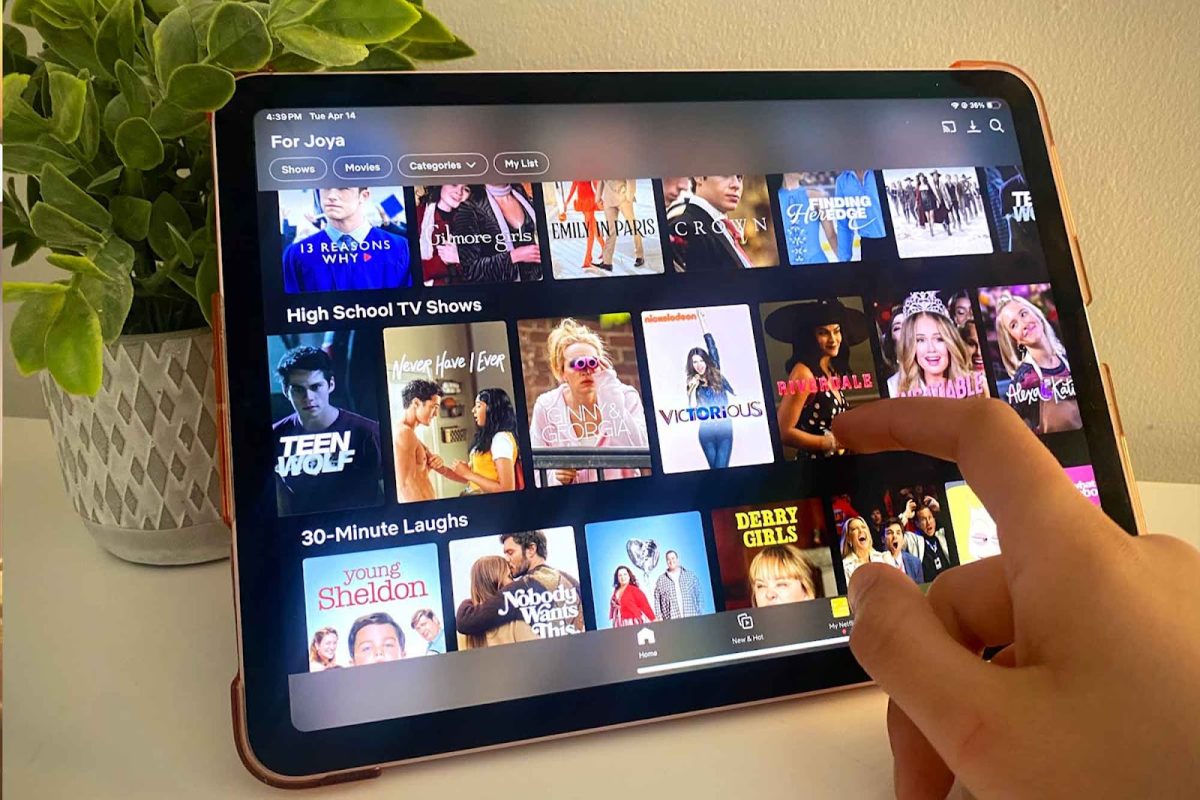
However, while it’s unlikely you’ll encounter this sort of unrealistic lingo in your English class, scroll through Netflix previews and your chances are suddenly much higher.
Television has always been a way for us to see ourselves reflected in stories of great adventure, romance, and comedy. However, in recent years, Generation Z faces more and more absurdly inaccurate portrayals of its character and values, and young people are beginning to take notice.
“I don’t think [the portrayal] is very accurate,” freshman Charlotte Garson said. “I think a lot of it is just a little bit too far-fetched, especially the way that we act and the things that we do.”
Statistics from global audience measurement site Nielsen show that 65% of shows watched by Generation Z are considered “library series,” meaning they come from and represent past generations. Common examples are “Gilmore Girls,” “Friends,” or “Grey’s Anatomy.”
We have to ask ourselves: is this time travel when it comes to television simply because they are classics, or because Gen Z feels unrepresented in the TV shows that are being released today?
A 2025 article from The Guardian describes what they call a “strange phenomenon in Hollywood”, stating that, “What once used to be a staple entree of the television buffet – TV that reflects young people’s realities, anxieties, fantasies and hijinks – is now a small subsection, neither drawing the eye nor tasting right.”
The hit series “Euphoria” may be the best example of this shift. Having just come out with its third season, “Euphoria” explores everything dark and twisted about modern adolescence. From hard drug use to child pornography, it’s safe to say Gen Z doesn’t always find the show comforting, or representative.
“In Euphoria, they really overstate the high school experience,” sophomore Abigail Bell Collins said. “Screenagers, drug use, and other things like that; it feels really overstated and misrepresented.”
Then, there’s the other side of the narrative. Many movies and television shows geared towards young adults seem to try and jam in as much modern lingo and social media references as possible until viewers are forced to pay attention.
“I think Gen Z is really painted as screen addicts, which is partly true,” Garson said. “I think they’re honestly painted a lot as sassy, and almost like stuck up and rude, which I don’t think is very realistic.”
This sort of cringey “slang” released in many modern shows leaves the impression that no one under the age of 35 had any say in the process; and, honestly, there might be some truth to that.
In fact, data collected by Stephen Follows shows that people under 30 account for only 2.1% of directors. Many youth feel like having more young voices behind the scenes would make a difference.
“I think they could definitely have somebody that is younger on set, because the perception that certain older people have in the film industry of Gen Z is a lot different than what is actually happening,” Sophomore Kai Czaplicki said.
Of course, there is the argument that the culture and customs of an entire generation can not be summed up in one TV show.
“I feel like [TV shows] are somewhat accurate, but not necessarily for Gen Z as a whole,” sophomore Margaret Hutton said. “Some people can relate, but I don’t think everyone can just because we’re all the same age.”
Truthfully, the thing that will turn the tide of this generational flop is characters who portray the real messiness, stressors, and dreams of young people. Of course exciting, unrealistic plots are enjoyable, but they need to be paired with protagonists that feel authentic.
TV shows like “Never Have I Ever” show the real craziness that comes with growing up in a world filtered through social media and high school pressures, while still maintaining a hilarious plot and feel-good narrative.
Generation Z is facing the enormous feat of growing up in one of the most complex eras the world has faced: social media, political polarization, and the age-old anxieties of high school. TV is meant to be an escape from reality, but to be portrayed as either cringey screenagers or depressed drug addicts feels belittling.
It’s time to create media that feels authentic for young people.
“Obviously for TV, you need to make things more dramatic than they actually are,” Garson said. “But, a lot of the time, I just don’t think it’s a realistic reflection on how Gen Z is really spending their time.”
Each opinion represented in The Panther Press is the view and voice of the writer. Opinions, as the selection and curation of content by the editors, do not represent the views of the entire Panther Press staff, the adviser, the school, or the administration.