
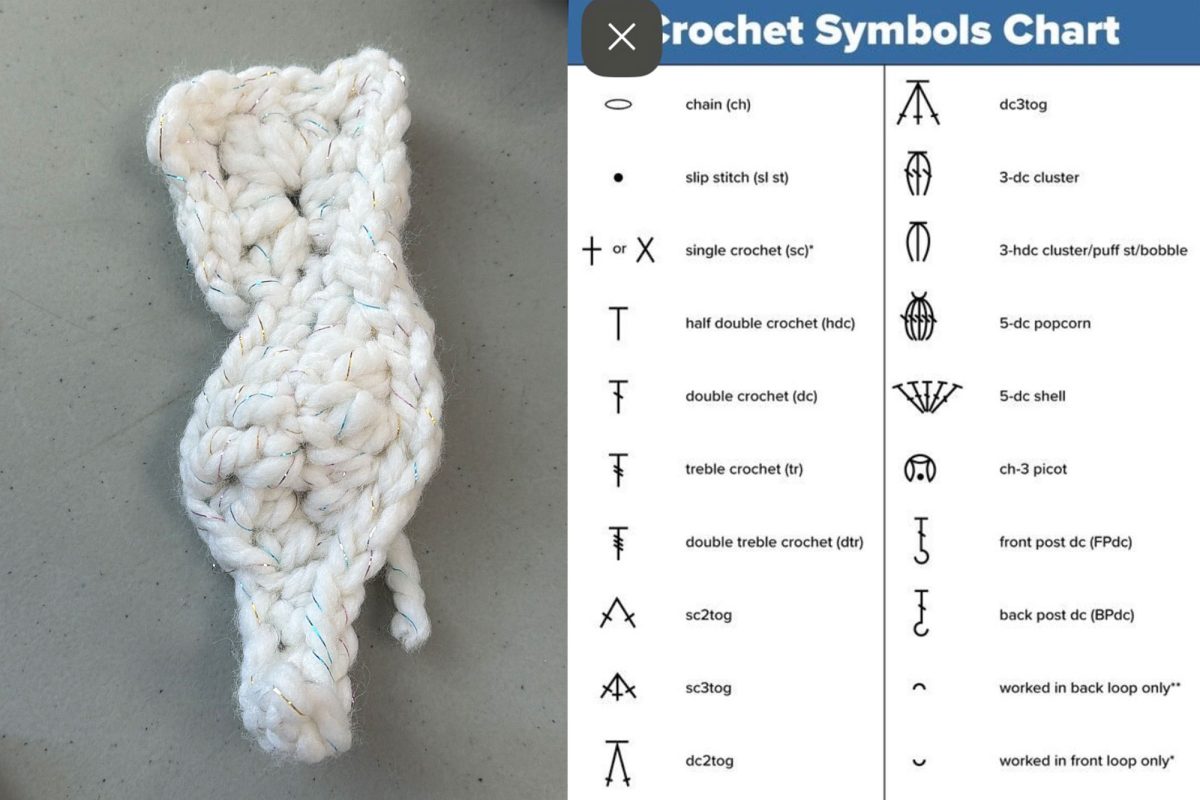
The word crochet comes from the French word of the same name, meaning ‘hook’. While the exact origins of the practice are unknown, there was an uptick of popularity during the 1800s. Its first written patterns were done during this period, and crocheting was an important industry during the Irish Potato Famine since it gave women products to sell.
Amelia Silva has been crocheting for two years, finding tutorials online to start.
“I saw some videos on Pinterest that were really cool, and I’ve always wanted to make my own clothes. So, this is the first step I took towards that,” Silva said.
For this project and any crochet projects in general, all you need is a hook and yarn. A pattern and a symbol guide can also be helpful, and they are both provided here.
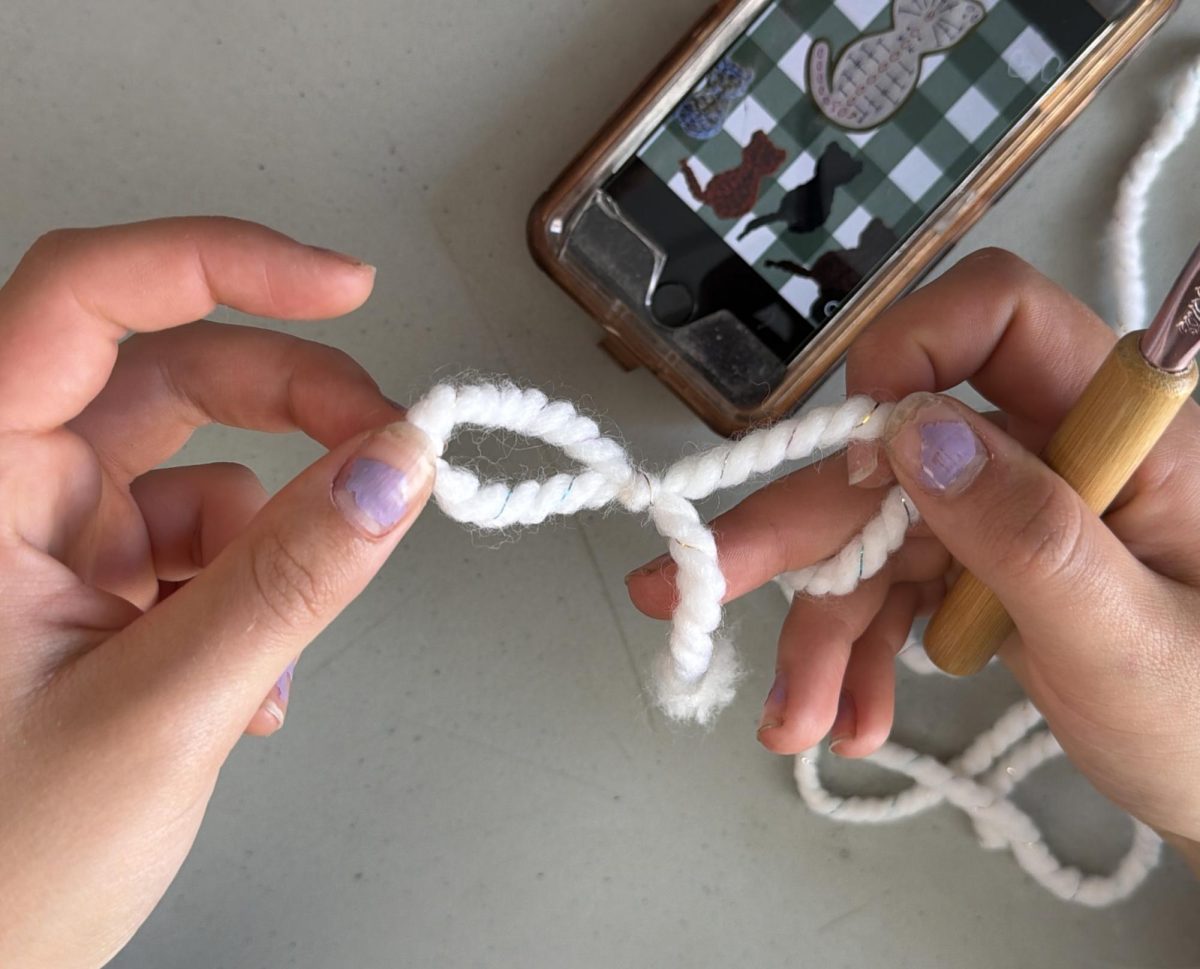
Silva explains that the first step of the process is to create a slipknot, by creating a loop and pulling the end of the yarn through. This will act as the center of the cat’s head, marked as one on the pattern.
After pulling the two ends of the yarn through, create nine stitches by inserting the hook into the stitch with the yarn over it, pulling it through with two loops over the hook, and pulling it through both.
The next step of the process is to make an extra chain, then skip two stitches and wrap the yarn around the hook. This will leave you at the number two on the pattern. Pull the yarn through, and do a half-double crochet. This is similar to a single stitch, except that there are three loops over the hook instead of two.
After this, do a double crochet, pulling the yarn through twice, then a triple crochet, wrapping the yarn around twice and pulling it through three times. Do another double, a half-double, then another single crochet. This is the first half of the cat’s body.
The next step is to do a slip stitch, where you pull the yarn through both the stitch and loop on the hook. To begin the head, do a half-double crochet, a double, another half-double, a chain, then three doubles. Afterwards, do a chain, a half-double crochet, then a double, then a half-double. This is all in one stitch, and will lead down to the rest of the body.
After this, do another slip stitch, a single chain, a half-double, a double, a triple, then a double. This is a reflection of the first side. Once finishing these steps, it will end up at number three, marked on the pattern. Make six chain stitches, skip one, then do six single stitches down the length of the tail.
Silva prefers to do slip stitches around the body and head to create the ears, which has the added benefit of going back where the ears are placed and allowing the craft to lay flat a bit easier. To make an ear, she does a single crochet, two chains, then a slip stitch. Afterward, she goes to the other side of the head, and does the same process for the other ear.
To finish the project, Silva cuts off the excess yarn that she did not use, and pulls the end through. She prefers to weave in the end to get a more seamless look. After this step, the cat is finished.
Along with making plushies, Silva creates clothes, tapestries, and other trinkets she finds cool.
“[Crochet is] a fun way to express my feelings and put my creativity into something,” Silva said.