On the island of Aeaea one can find lush rolling hills, air that smells of sea salt, the honking of pigs, and a mysterious little cottage.
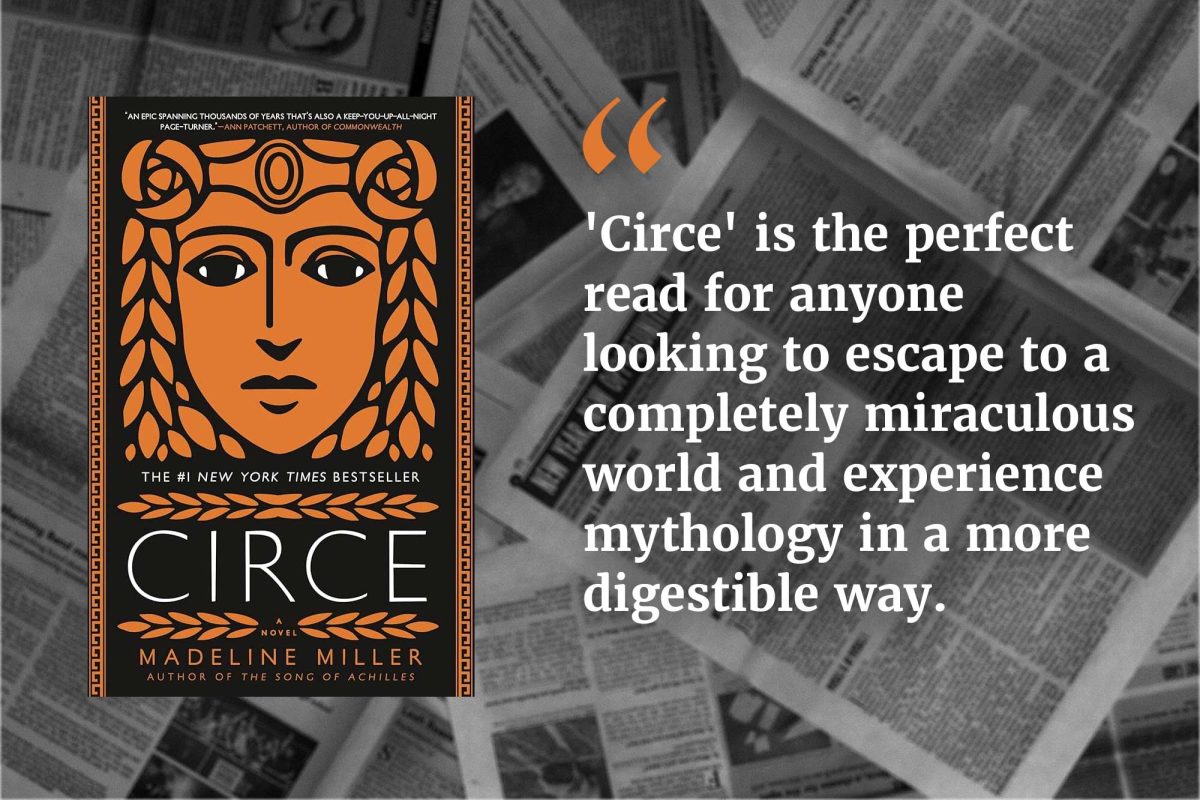
This island is not a real one, but rather a mythical fortress that serves as home to the Greek goddess, and more importantly enchantress, Circe. The novel “Circe” by Madeline Miller recounts the life story of such a goddess and such an island, offering an intimate peek into the vast world of Greek mythology. Miller is also well known for her bestseller novel “The Song of Achilles.”
Set during the Greek heroic age, “Circe” follows the daughter of son god Helios through her banishment from her birthplace, and to all the hardships and miracles that await her on the island of Aeaea. Through centuries (literally) of livelihood, Circe must confront the all enveloping power of loneliness, the never ceasing presence of the greater Greek gods, and what it means to truly be alive.
One element that makes the book so enrapturing is Miller’s voice as an author overall. Throughout the novel, she sticks with simplistic yet incredibly moving narration that makes for a quiet atmosphere, perfectly capturing the life that Circe herself leads. The book actually has little dialogue, and while there are moments of action the whole thing feels grounded in a way that perfectly represents the solitude of Circe’s life.
Another one of the most undoubtedly entertaining aspects of the book is its timeline of Greek mythology. The book intertwines with some of the most brilliant works of the Greek age, including “The Odyssey” (If you recall, Odysseus takes a little trip to Aeaea himself), the story of Icarus, and the Minotaur.
A major draw for me is the way that the book comments on the Greek disparities of men and women, and the brutal behavior of men that is often excused in traditional tellings. While the classic works depict Circe, and women in general, as nasty witches, Miller’s telling brings a gentleness and femininity to the stories instead.
Circe encounters a great deal of men on her island, both good and bad, kind and deceiving, and is a powerful representation of a woman doing what she needs to survive, even if it means being viewed as wicked by the rest of the world.
One plotline that I also found to be interesting is that of Circe and her son, Telegonus. The reader gets to see Circe grapple with the difficulties of raising a child, a task that even proves to be taxing for a goddess. Through their relationship, Circe’s character undergoes much growth.
The plot of “Circe” does not follow the distinct story arc that is so commonly found in novels today, but is rather a more ongoing narrative that covers shorter bursts of conflict. This style is not fit for all readers, and some may find the pace to be too slow or boring. Personally, I think it provides a unique reading experience!
“Circe” is the perfect read for anyone looking to escape to a completely miraculous world and experience mythology in a more digestible way. You do NOT need to be an expert on Greek myths to pick up this book!
“Circe” may just be your Achilles heel when it comes to finding the perfect read.