Artificial Intelligence (AI) is highly regarded as the technology of the future. AI systems are being used to revolutionize automation and health care, but AI has weaved itself into daily life now, too.
Today, AI systems are integrated into social media algorithms, photography applications, and search engine platforms. Whether you realize it or not, AI is being used to power your daily routine.
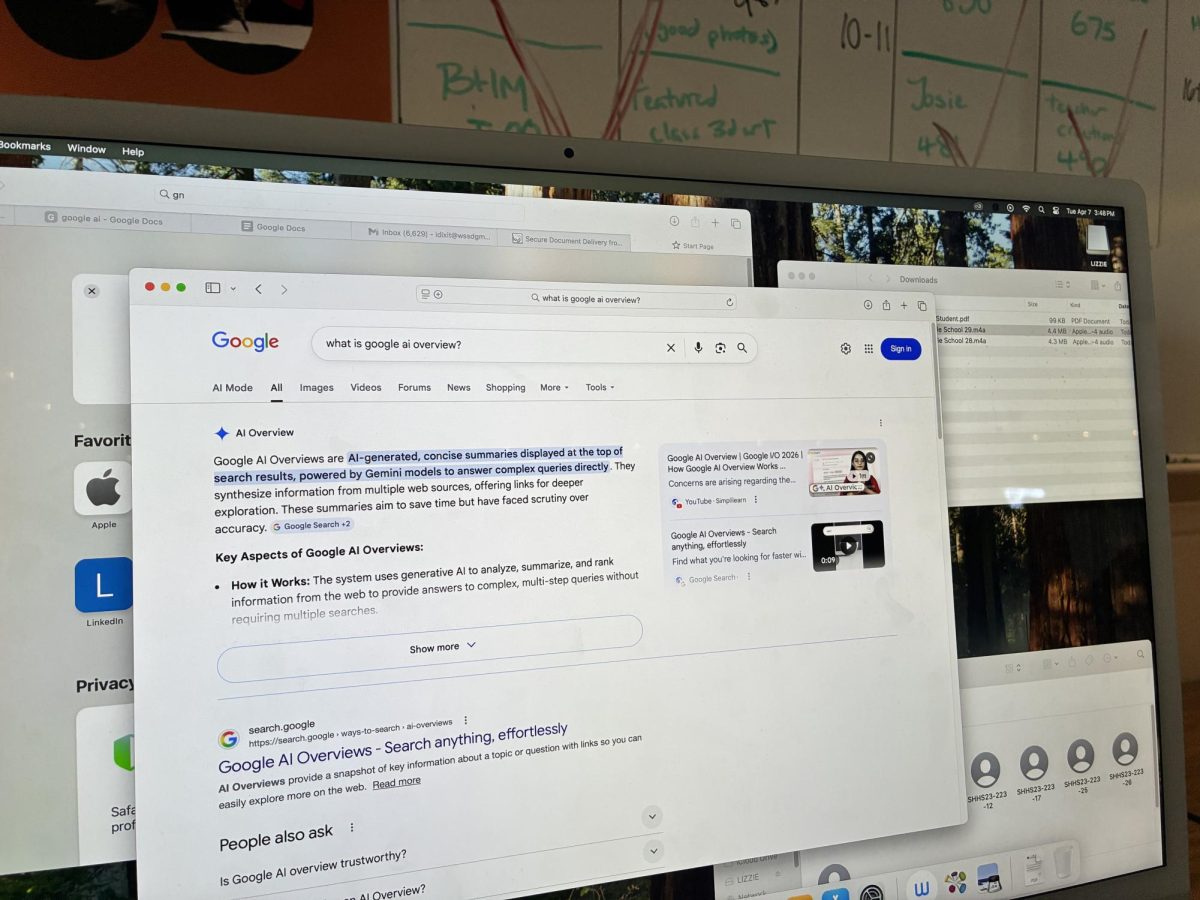
Google officially launched their Google AI Overview feature, a tool that summarizes search results, on May 14, 2024. Since then, the tool has been modified and expanded to be made available to a larger number of users.
AI Overviews are powered by Google’s LLM (Large Language Model), Gemini, in hopes of streamlining the process of searching for information on Google. By comprehensively summarizing and outlining information, the feature can reduce the time it takes to gather information.
“I’d say, on net, [Google’s AI Overviews] probably make research more efficient,” senior Yuhang Li said. “If you don’t know much about the topic, it at least provides some sort of ground for you to research further into the topic.”
Li finds that, on the school computers, these overviews can bypass a number of obstacles that may come up when looking for information.
“I feel like I do rely on the AI overview probably more than I should, but at the same time, I feel like that’s not necessarily an issue with the AI overview, but maybe more so other websites,” Li said. “The school Chromebook sometimes has other websites blocked, and sometimes the other websites are ad-infested.”
For these reasons, along with others, often skimming the overview is more convenient than searching for and clicking on links to official websites and articles. This habit, however, is dangerous for publishers, content creators, and digital marketers, who rely on users to click onto their websites and platforms.
“If you use the AI overview to search something, Google’s bots scrape websites for the content,” Li said. “The bots can’t watch ads, so I think it definitely affects website traffic.”
This idea has been proven true. In fact, Medianama reports that such overview features decreased link click-through rates by around 58%. Press Gazette finds that a drop of 20-40% in revenue for some publishers is attributed to this decreased click-through rate.
Another concern of the overview feature is its ability to make errors. While some errors are humorous, for example its suggestion to consume one small rock per day and add glue to pizza, other errors can be more difficult to distinguish and, thus, misguide research.
“If you don’t know anything about the topic, and if the AI overview gets it wrong, then that’s a little problematic,” Li said. “But at the same time, if the AI overview is getting information wrong, you can typically figure out that it’s spewing something weird, if you’re doing some research.”
The problem arises when students do not bother to research further, and merely rely on Google AI Overview’s summary.
English teacher Mr. Robert Zakrzewski assigns creative projects for students in his class. One such project asks students to compile music that aligns with the theme of works of literature, like “The Great Gatsby.” He finds that some students skip critical steps during the process of researching for the project due to the availability of AI’s ideas.
“I’ve seen [students] go directly to Google to find what they’re looking for instead of searching through the text or brainstorming more on their own,” Zakrzewski said. “Usually this is one of my favorite projects to receive from the students… But, it was obvious, they’re picking the songs off what they had seen on Google and that defeats the purpose, and really is a waste of time for everybody.”
Zakrzewski notes that the most concerning part of this reliance is its impact on creativity.
“[AI overviews] are harmful if they start to take away from a student’s ability to create on their own,” Zakrzewski said. “What worries me is if we’re just going to blindly accept the first thing we see without having the critical thinking skill of asking, ‘Well, where is this coming from? Is this correct?’ I think that’s an essential part of education.”
However, Zakrzewski finds that students are capable of asking these questions and determining whether or not the AI overview is reliable.
“I’m glad to see students are not just blindly accepting everything that the computer says,” Zakrzewski said. “I think a lot of older people have that fear, but kids aren’t dumb.”
Many students are also aware of what the pros and cons of AI usage are. AI use is not always glorified or encouraged by peers.
“It’s become slang and kids might make fun of each other, saying, ‘Oh, that’s AI’ or saying it’s ‘AI slop,’” Zakrzewski said. “So there is a stigma against it within young people that I think is healthy.”
By understanding and properly evaluating the AI tools that are being integrated into daily life, one can utilize these tools to make the research process more efficient.
“Anything that can help [students] brainstorm or see potential ideas before they go down a road that’s not going to work out can absolutely make [researching] easier,” Zakrzewski said. “In some cases, I think it’s great because it helps them get their ideas together quicker, or maybe better.”
Some teachers, like Zakrzewski, are also employing different methods to help students avoid full dependence on AI generated content, encouraging students to continue to think critically.
“I have been trying to change my assignments to have more personal elements in them than before,” Zakrzewski said. “A lot of our academic writing is very objective…think about the five paragraph essay, for example. That’s exactly what AI does really well, so I’m trying, even if it is an analysis essay, to ask students to tie in a personal element to it, so that students have to still draw upon themselves.”
AI tools are new to everyone, and their spread warrants adaptation. It is important to understand the tools available to use them correctly and safely.
The district introduced a first draft of a new AI Administration Regulation (AR) within policy 815: Acceptable Use Of Technology. It was first read at a policy committee meeting on Feb 3. The policy outlines that the “use of generative AI by students is only allowed to the extent stated by the teacher for an assignment.”
The policy aims to provide language for teachers and students about the usage of AI in the classroom.
“Teachers and students alike are both in the wild west for this,” Zakrzewski said. “I feel like we’re all on the same page, and that’s a really interesting time to be in. I think it can be exciting, but scary. We’re all in it together.”