As someone who’s considered herself an artist all her life, I’ve struggled to separate art from the idea of something that is visually pleasing, precise or perfect. I’ve been the person who rips out pages of my sketchbook when I didn’t get the proportions of something quite right, who threw out whole canvases because I accidentally let two colors bleed into each other.
Art doesn’t need to be realistic, perfect, or even beautiful to still be art. At its core, art is just another way that we can express ourselves, like speaking or writing. Our feelings aren’t always clear, and they usually aren’t pretty.
That’s why pieces like “Saturn Devouring His Son” by Francisco Goya are still works of art. Maybe you wouldn’t hang it up in your house, but the emotions still cut through, and that’s the point.
“Offensive” modern art like Yoko Ono’s “Cut Piece” or “The Dinner Party” face a lot of criticism from people both inside the art world and outside of it. Before adding your two cents on modern art, it’s important to consult the past.
Renaissance art like Michelangelo’s “The Last Judgment” or Caravaggio’s “Judith Beheading Holofernes” were harshly condemned for their nudity and realistic depictions of violence. Today, those works are revered and artistic nudity and gore are widely accepted.
The world is constantly shifting perspectives and people evolve to be more open minded. As people living in our own time period, we see our social constructs as the only way one could possibly live.
But just because we feel that way doesn’t mean it’s true. Just like we might frown upon the people who campaigned to cover the genitals of famous figures like Michelangelo’s “David” with fig leaves, we should understand that even if something makes us uncomfortable, that doesn’t mean it deserves to be criticized or censored.
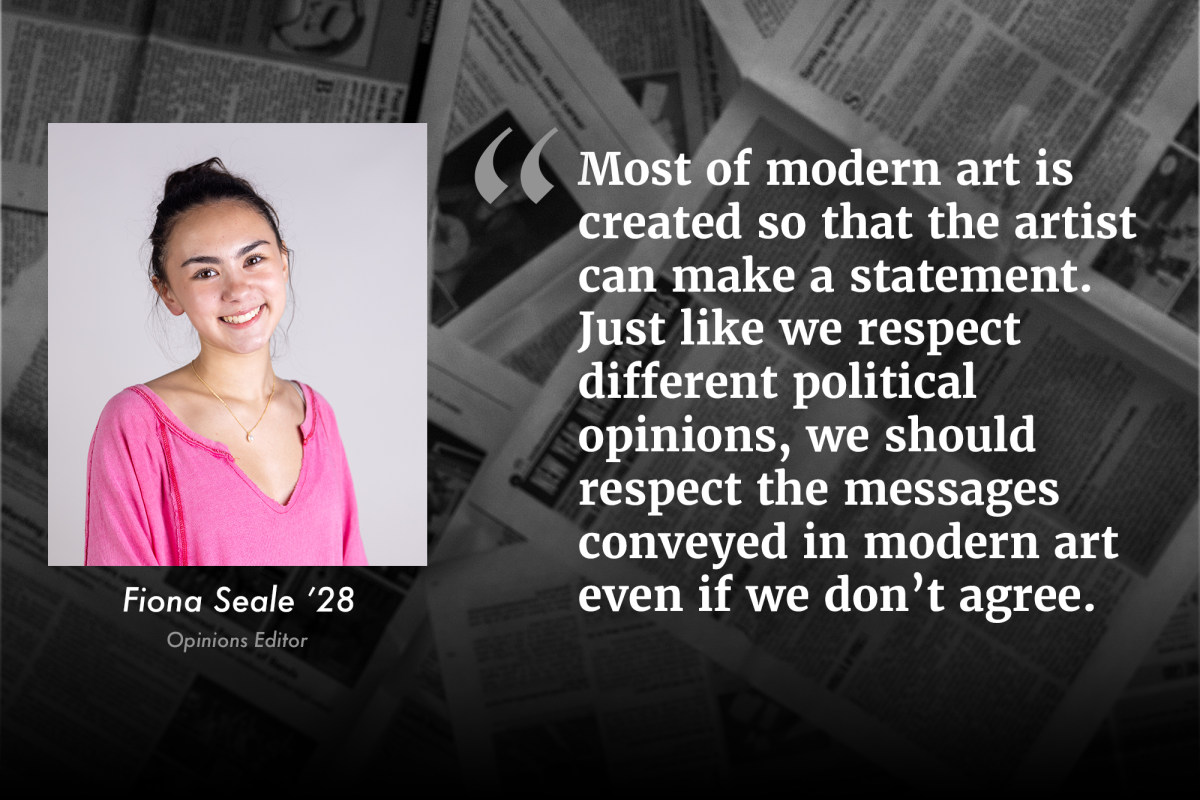
Most of modern art is created so that the artist can make a statement. Just like we respect different political opinions, we should respect the messages conveyed in modern art even if we don’t agree.
Who knows, maybe that banana duct-taped to a canvas you made fun of is going to be as famous as the Mona Lisa in a few hundred years.
Abstract art like Georgia O’Keeffe’s “Abstraction Blue” or Robert Delaunay’s “Endless Rhythm” deserve the same reconciliation. Art was never meant to be a competition, or purely a showcase of skill. Just because abstract art is simpler, doesn’t mean it carries no meaning.
Art is meant to provoke introspection, and if we can’t put in the effort to look a little deeper into an art piece, then we have lost art’s purpose, and we have no right to criticize it.
But beyond that, maybe art doesn’t need to have a specific meaning to be important. Maybe the artist just thought that two colors painted next to each other would make him happy, who are we to judge that?
Simple art with simple messages can still hold immense meaning, and they aren’t inferior to more complex artistic expression.
Think back to mankind’s earliest examples of art, like cave paintings of local wildlife or even hand or finger prints. Those ancient artists weren’t trying to create something of the highest technical value or realism, they were only attempting to convey a basic message: “These are the animals I am going to hunt tomorrow,” or, simply, “I was here.”
I don’t think the cavemen were upset that the water buffalos didn’t have the exact proportions of a real water buffalo. It was the expression of their thoughts that mattered.
If you don’t like abstract or modern art, that’s fine, skip over it on your museum prowls and stick to your still lifes of grapes in bowls. Everyone has their own definition of what art means to them, whether it’s something beautiful, technically impressive or complex in meaning. Just because some of it doesn’t fit your definition, doesn’t make it any less of a work of art.