While reading the required 1925 novel in my sophomore English class, I realized that, despite the obvious cultural differences and slightly confusing Jazz Age slang, F. Scott Fitzgerald’s “The Great Gatsby” doesn’t feel too far removed from today.
The further I got into it, the harder it became to shake this feeling of resemblance. Where have I seen this before?
Stripped to its core, “Gatsby” is more than a tale of romance and money; instead, it shows the lengths people will go to polish their image. Jay Gatsby carefully constructs a version of himself, decorated with lavish parties, mysterious amounts of wealth, and rumors that make even me think, “Who is Gatsby?”
While most of us teens don’t spend our time at extravagant parties or fabricating backstories, we do share something scarily similar to Gatsby: our tendency to curate our lives to make us look absolutely perfect.
Scrolling through Instagram, it’s hard not to notice how carefully constructed everything is. It isn’t entirely fake, but it does lack a sense of personality or authenticity. Our photos all look eerily similar, sharing the same poses, captions, and settings. Over time, we’ve forgotten the original idea of social media — to document our lives — and replaced it with a warped version of it.
Gatsby’s parties function in a similar manner. No one really knows who Gatsby is — he’s this intangible identity that no one can really get their hands on. People show up not because they know Gatsby, but because of what his life seems like from the outside. To put it more eloquently, the spectacle outweighs the substance.
For example, in Chapter 3 of the book, guests casually repeat rumors about him, some claiming he’s a war hero, others that he’s a murderer. Yet the fact that no one knows for sure who Gatsby is shows that Gatsby’s self-created image is enough to overshadow his past.
This same detachment can be eerily similar online. I scroll past dozens of posts, and by the end of it, I’m not sure I’ve actually learned anything about anyone. Everyone’s posts blur together into an indistinguishable blob of smiles, and I go to bed thinking about how inauthentic we have become.
One of the most well-known and studied symbols in the book is the green light, which symbolizes Gatsby’s longing for something just out of reach (I won’t spoil anything, just in the off chance this gives you an incentive to read the masterpiece of a novel). Gatsby is seen holding his hands out to the light, showing how distant, idealized, and unattainable his hopes are.
We reach for a green light, too. The green light can just as easily be an idea as a person or place, which is why it makes an accurate symbol of what we’re trying to become online.
Our images are constantly reinforced online. There is a very specific type of post that has become acceptable, and there’s a method to the madness. And just like Gatsby, the typical response isn’t to question this madness but instead to adjust and refine things that match it.
Gatsby’s story is arguably most unsettling because he never seems to notice how committed he is to this long-lasting effort to prove himself. In fact, he becomes so absorbed in this fake persona that he actually sees it as more real than the person beneath it.
None of this is to say that social media is entirely fake or artificial or that everything posted is meaningless. Like Gatsby’s world, there are moments of genuine connection and development. But it is so hard to ignore how much effort goes into maintaining a certain image, especially when everyone seems to be doing the same.
Which might explain why, despite everyone trying to appear unique, so much of it ends up looking identical.
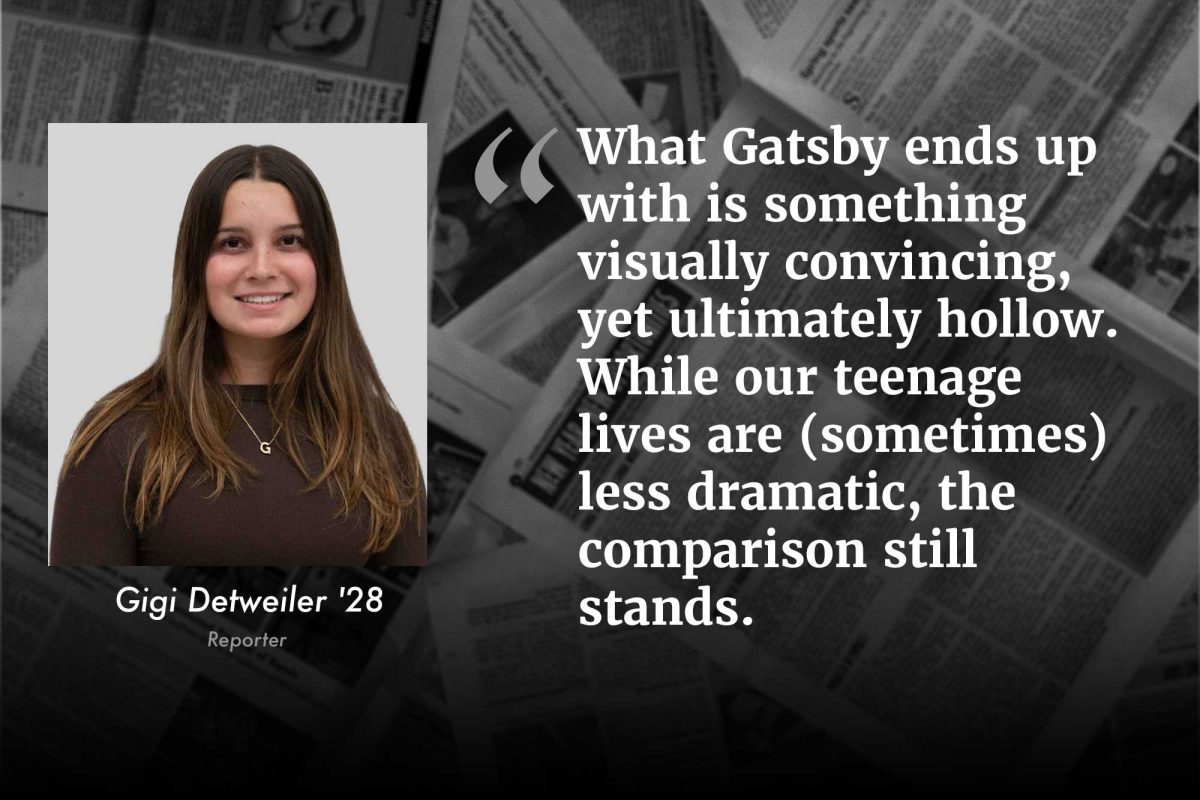
Gatsby sets out to create a life better than his past, one that will finally feel complete. What he ends up with is something visually convincing, yet ultimately hollow. While our teenage lives are (sometimes) less dramatic, the comparison still stands.
We may not be reaching across a bay toward a distant green light, but we are still, in our own way, adjusting our own pictures, hoping that if something looks right, it will feel right, too.
Perhaps that’s where the comparison becomes more uncomfortable. Gatsby never really questions what he’s chasing; he just keeps going. It’s worth wondering if we do the same.
So maybe it’s time to stop chasing the green light that is image and be true to ourselves. Bring back posting what makes you cool and different. Stop checking your inbox for constant compliments. Turn off your notifications, post whatever you want, whenever you want, and live in the moment.
Each opinion represented in The Panther Press is the view and voice of the writer. Opinions, as the selection and curation of content by the editors, do not represent the views of the entire Panther Press staff, the adviser, the school, or the administration.