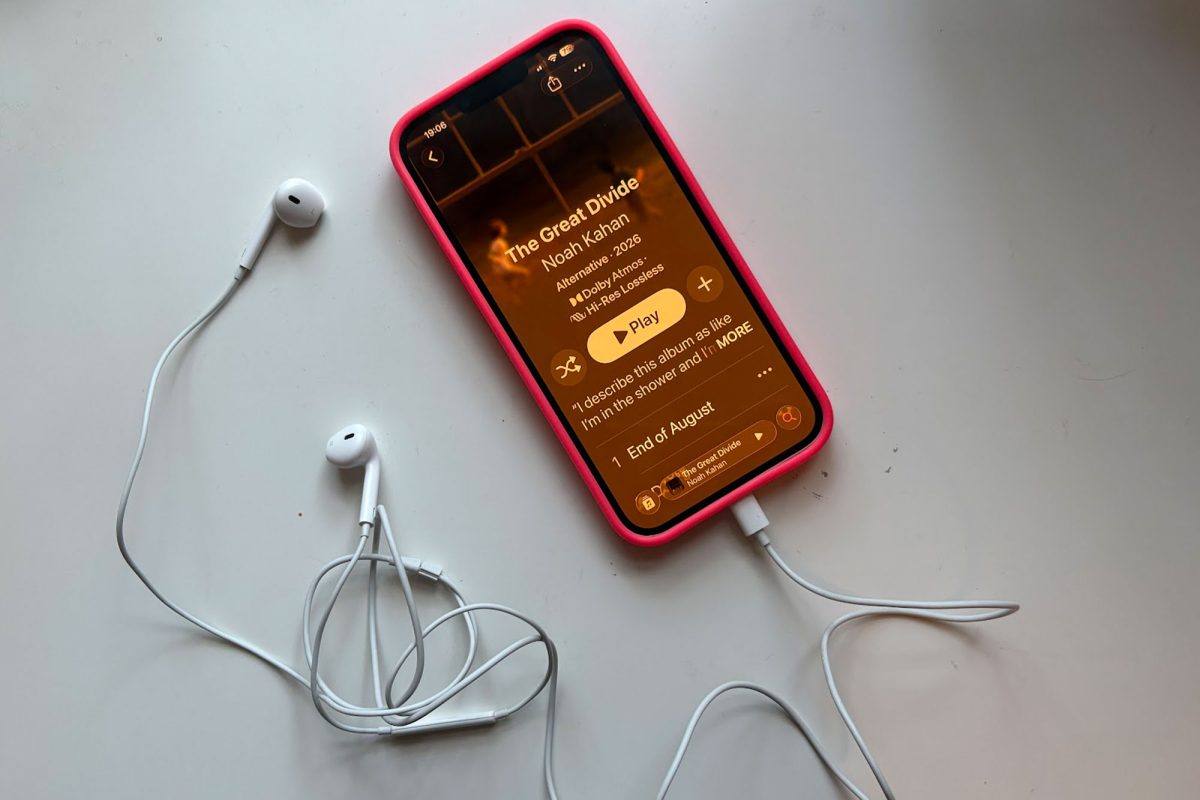
Music exists almost exclusively online now, from streaming services like Spotify which bring us all the sonic escape we could hope for, from Chappell Roan to brown noise (what even is that)? Most people under the age of 65 only buy records to hang the cover on their wall.
Social media interaction has filled us with a need to classify everything. For instance, the reason Taylor Swift is so popular is because her albums can be easily sorted into eras; they have been defined by specific colors, aesthetics, images and motifs, and the actual music cannot be separated from their visual representation. People love to put things into boxes, because it makes everything simpler and more digestible.
This is part of the reason pop music has become so repetitive. If each song does not fit the perfectly curated vibe or aesthetic of a record, the Tiktokified brains of fans cannot understand its place in the project and will be quick to call it messy or non-cohesive. This often takes away from the complexity and nuance music can portray. Pop music is now curated to go viral on social media, prioritizing shorter, catchier moments and simpler lyrics, with viral potential.
Social media has even fundamentally changed the way music is produced.
“It’s changed the structure of a lot of pop songs. What’s going to catch people on TikTok is a really hooky chorus or an amazing bridge. You’re seeing artists re-jiggering songs so that people can pick out those little snippets and create that viral moment,” former Philadelphia Inquirer entertainment and music writer, current Philadelphia Inquirer Deputy Managing Editor of Live coverage and breaking news Molly Eichel said.
Before social media really took off, the loudest voices in music were journalists, writing researched and educated long-form reviews. Now most music content the average person will consume is short and scrollable. It wants to catch your attention by focusing on shocking visuals and eye-catching motifs rather than the actual music.
“There’s more of a motivation to get clicks and have sensational articles that drive profit instead of being motivated to have true journalistic standards,” history teacher, music enthusiast, and former recording artist Mr. Jonathan Pitts said. “I think the pressure to generate clicks profit means that people that are writing about music are now writing about it in a very superficial way. It’s easier to write about someone’s looks and appearance than it is to write about the sonic qualities behind music.”
This shift from journalistic documentation to online media has contributed to the idea of artists being brands and actual music being a product rather than an experience.
Now that we are on our phones all the time, artists have become uber accessible, allowing them to profit off of the fact that we can watch their every move online. They build their brand using those tools.
Think of stars like Sabrina Carpenter. Her career only began to take off when she fully committed to her coquetish look, juxtaposed by raunchy double-entendres. She now profits off of that idea through social media audits.
Sophomore modern band vocalist Luke Hanna points out this phenomenon in other popular artists.
“An artist that kind of reminds me of Benson Boone. [Junior Thandiwe Jemwa sings Benson Boone’s “Mystical Magical”] See, it’s stuck in her head. He’s in multiple ads that I keep seeing constantly. He is just this brand, this product, that everybody can use,” Hanna said.
While this focus on branding has been amplified through social media use, Eichel argues that it has always been around. The Beatles trademarked the London boy look and The Ramones were classified by their Converse and leather jackets. This issue is really that social media music marketing is done more intentionally.
The internet can make finding new music easier and accessible, allowing people to develop identity through music that may not be playing on the radio all the time.
This diversification can have downsides, especially when one of the main draws of music is to bring people together.
“When I was a kid, we had nothing to do on Saturday nights, so we would get in our friend’s car, drive around and change the radio station until we heard Missy Elliot’s ‘Work It,’ which, at the time, was a very big song,” Eichel said. “We were obsessed with it. We would just change the radio station until we heard it.”
At the time, Eichel loved the fact that so many of her friends all knew the words to the same songs.
“Now it’s a little bit more separated than that, which is good, because it means that there’s more diversity in what people are listening to,” she said. “But I’m sad about the lack of monoculture that we have now.”
Another worry with the internet’s effect on how we listen to music is that the total accessibility we have through streaming services makes it feel almost disposable.
“The thing that made it so special back then, people actually using record players not just for display, is that you’ve got to digest the music,” senior modern band vocalist Thandiwe Jemwa said. “You’re not over stimulating your brain with so much at once. I think that helps a lot to really understand what’s going on because when I’m just sitting there and I’m digesting what’s what I’m listening to and not watching a music video, it’s more impactful.”
It’s nearly impossible to extract music from its visual counterpart entirely, those artforms tend to go hand in hand. The influence of MTV, music videos, live concert performance and dress are critical to how music is perceived.
However, it’s important to separate your enjoyment of music from its corresponding digital content. Don’t base your opinions on musical releases on some 30-second TikTok critique. Before stanning a new artist just because of a cool outfit they wore on Instagram, take your time in deciding your opinion of that artist, listen to their work and then determine if you’re truly a fan.
Just because you like an artist doesn’t mean you have to buy their makeup brand, their skin care, or their Crumbl Cookie. It not only harms the environment, but also minimizes what music is truly about.
Sometimes it’s okay to just sit back and listen, and I mean really listen. Not while doing something else, not while you’re scrolling. Go out, buy a record and actually use it.
“I think holding a record and paying money for it makes it a little bit more special,” Eichel said.
Each opinion represented in The Panther Press is the view and voice of the writer. Opinions, as the selection and curation of content by the editors, do not represent the views of the entire Panther Press staff, the adviser, the school, or the administration.