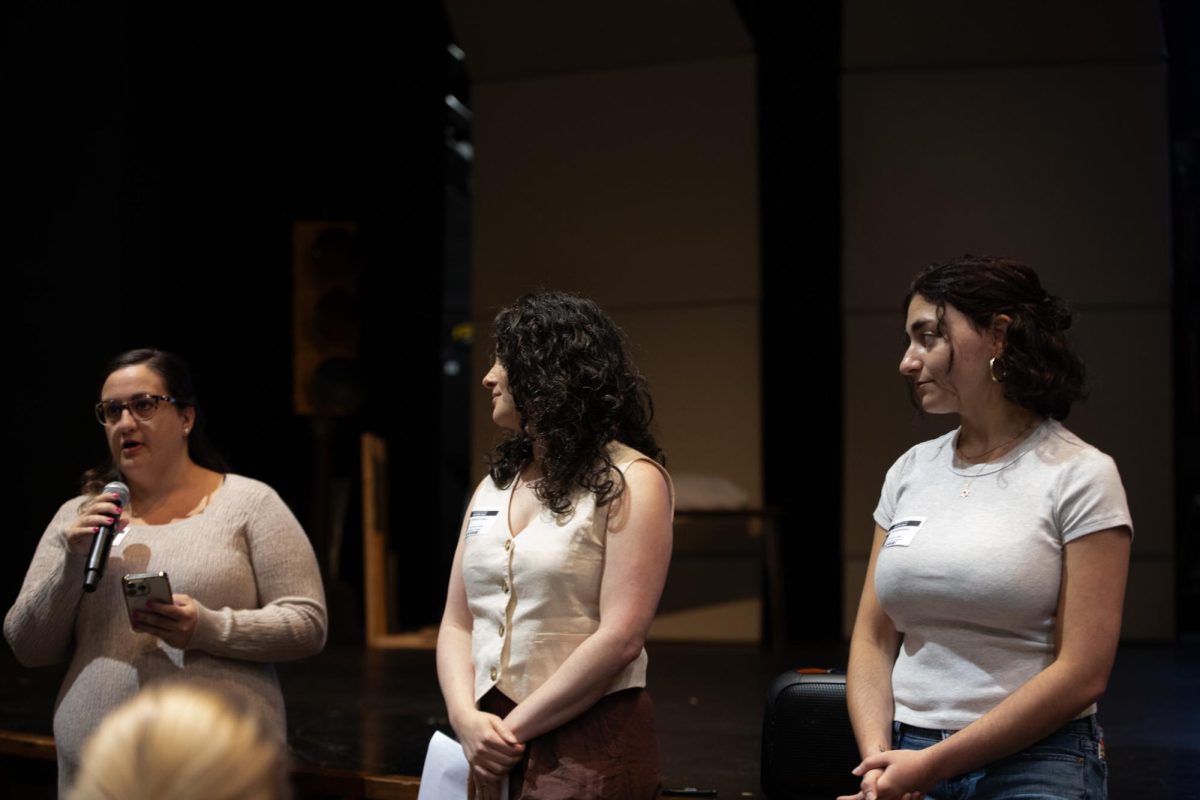
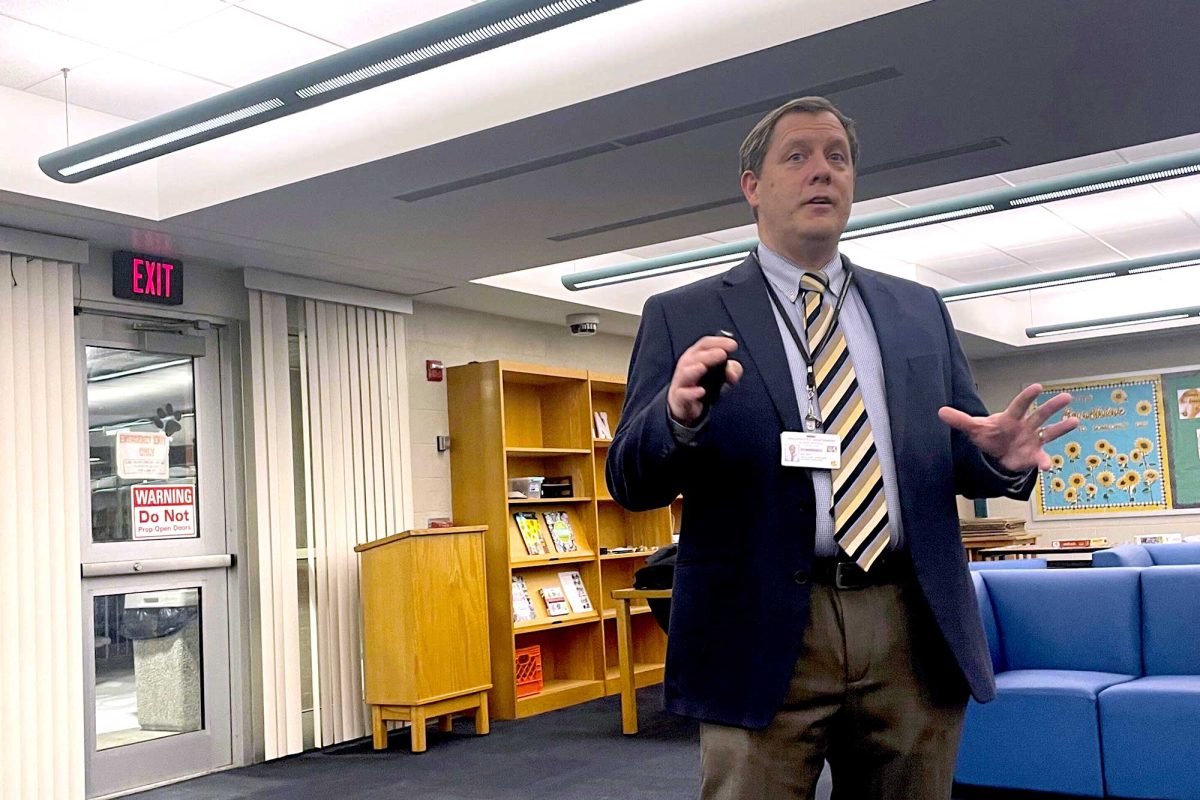
The architects were carefully chronicling every comment as WSSD administrators held a community forum regarding the high school renovation project.
The Feb. 4 forum took place in the library, with principal Mr. Andrew Benzing presenting on possible changes to numerous areas of the school. The high school renovation project has been a topic of discussion for over two years now, eventually becoming a part of the district’s ten-year capital plan.
“Warm, Safe, and Dry” has been an oft-repeated description since the district developed plans for the project. Thus far, building systems improvements to the roof, elevators, fire alarms, electrical, HVAC, ceilings, and flooring have all been under the umbrella of the term.
Recently, however, replacing the trailers and developing new learning spaces have all been included in the purview of “Warm, Safe, and Dry.” Superintendent Dr. Russell Johnston emphasized new life skills classrooms as a non-negotiable improvement.
“It’s really not up for debate, and that’s really about the life skills classrooms that we want to have here,” Johnston said. “We didn’t ask your opinion on that, but I want to make sure that’s understood, because it’s something that we feel like we really just have to do.”
Such improvements were not the main focus of the forum. Instead, it concerned ideas that are less set in stone, including transformations of the library, pool, locker rooms, cafeteria, auditorium, and adding an auxiliary gym.
Throughout the meeting, Benzing placed an emphasis on flexibility, asking for ideas on how to improve spaces that are underutilized.
“With a little bit of repurposing and shifting around, all of a sudden you have spaces that you didn’t like [with a new purpose],” Benzing said.
Multiple community members brought up the large number of lockers populating the high school, many of which go unused. If spaces like the Green Mile were not quite so dominated by lockers, perhaps they could offer more utility, the community members offered.
Benzing also raised the idea of repurposing elective classrooms meant for things like engineering or cooking to also accommodate other types of classes.
“When those courses aren’t running, and teachers don’t teach four blocks a day, it’s really difficult for us to utilize [elective classrooms] safely,” Benzing said. “We have to teach math classes… I won’t tip my hand too much, but the idea of flexibility in these spaces is something that’s important to us.”
Flexibility is also a pursuit in athletic spaces. Community members discussed the possibility of an auxiliary gym, which would lighten the load on the main gym. Such a benefit would be especially pronounced in the winter, when cheerleading, basketball, and other sports all utilize the gym.
Community members also discussed potential renovations to the pool, floating the idea of renting it out to the community to save money.
One potential change that would directly impact students was Benzing’s idea to add more flexibility to the cafeteria in pursuit of a change from three lunches to two.
“The idea [is] that if we could somehow break that down to two lunches in a given day, that’s going to give us a period of time without losing any instructional time where we could really get creative with programming that happens in the school time,” Benzing said.
Benzing mentioned letter of recommendation writing, tutoring, opportunities to meet with an interventionist, and social-emotional Learning (SEL) lessons as potential activities during the block of time created by a reduction to two lunches.
According to Benzing, the cafeteria currently holds around 450 students, with some additional space by the Wall of Honor hallway and in the library. But shifting to two lunches would cram around 600 students into each lunch, requiring significant changes to the spaces where students can eat.
Students already have some experience with only having two lunches. Twice a year, the Keystone testing schedule shortens blocks and condenses the lunch block into two lunches, resulting in a crowded cafeteria.
“I don’t think that would be very great,” freshman Eva Cielo said. “I know we’ve had two lunches before, and people are sitting on the floor in the hallways and sitting in the music room, and there’s nowhere near enough space.”
Cielo was one of the only students who came to the forum. For her, the most critical change would be improvements to the bathrooms.
“I think they’re in extremely rough condition,” Cielo said. “The sinks leak. The toilets leak. It’s moldy. It’s just very gross in there. Everyone uses those, and it applies to everyone. I think that’s very important.”
According to Benzing, changes to the bathrooms will be coming through the renovation project and will fall under the umbrella of “Warm, Safe, and Dry.”
“If the bathrooms don’t get renovated through this, then I’m moving out,” Benzing said. “If there’s only one thing we do, it’s got to be the bathrooms.”
After meetings with Kelly Clough Bucher and Associates (KCBA), the architectural firm the district has selected for the project, another forum on potential changes will be held on March 5.
Given the budget constraints exacerbated by recent fiscal problems, administrators and architects are looking at the forum as a way to prioritize and decide which renovations are truly needed.
“I think that’s the main thing of what tonight was about, hearing from the community exactly what the priority should be,” Ryan Orr, principal of KCBA for the project, said.