
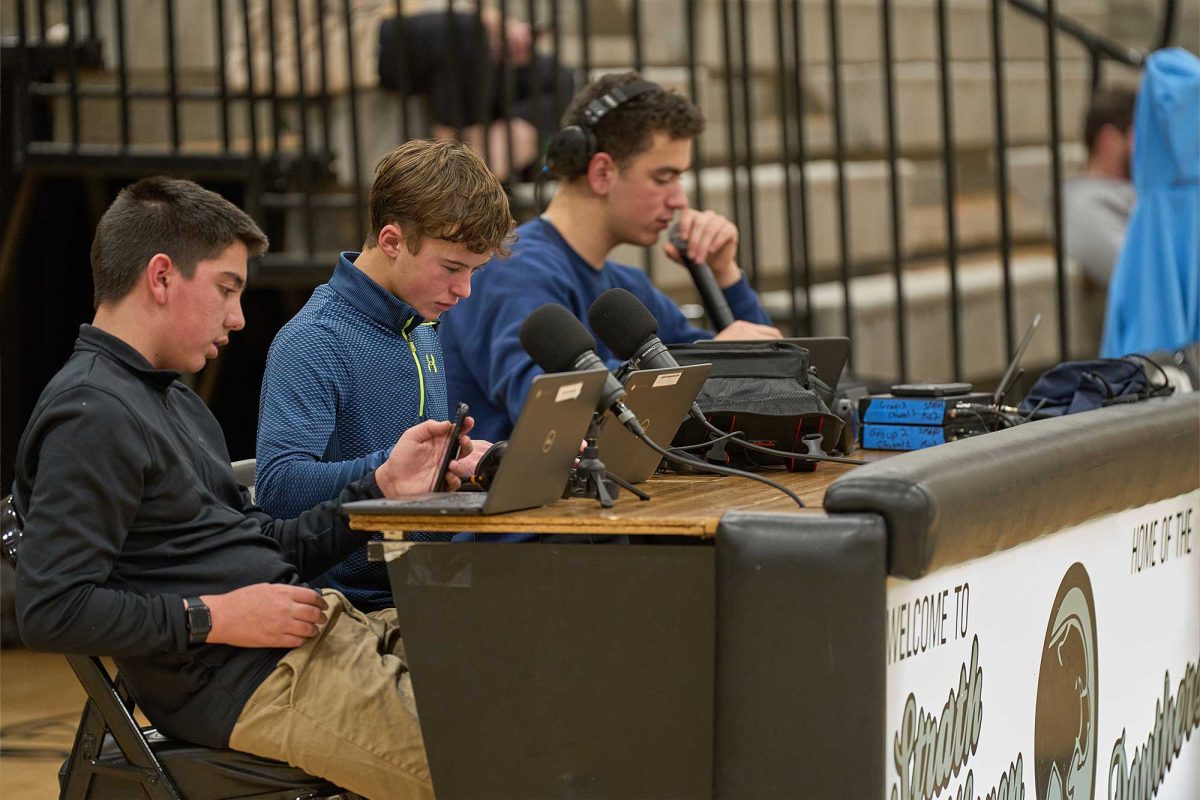
Student athletes run across the gym floor while SMASH members adjust headphones, type on computers, and speak into microphones to the entire audience.
SMASH tackles broadcasting games, sports statistics, social media, and bi-weekly highlights.
“A lot of SMASH is planning and working with coaches and the athletic director. It’s a lot of organizing, working as a team with everyone, and trying to make the best product and promote ourselves in the best way possible,” sophomore Blake Karabin said.
Karabin, who joined the club in its beginning stages and looks forward to being associate broadcasting director next year, has a lot to tackle in the time leading up to a broadcast, including meeting with the team, reviewing his script, and checking name pronunciations.
“It’s all student-led. The students set everything up, they broadcast, they break everything down for the different games that we have going on that week,” faculty advisor Mr. Patrick Keaveney said.
The entire club meets about once a month, leaving it to the student leaders to communicate, organize a schedule, delegate jobs, and fill in where needed.
“The big stuff is overcoming the difficulties of a lot of moving parts in the club, a lot of different people on different schedules,” senior and production director Eddie Gebhardt said.
According to Karabin, SMASH is manageable alongside schoolwork and sports.
“It’s a very collaborative club, and that’s why it’s the broad field of sports media, not just broadcast,” Karabin said.
Karabin has learned the importance of professional conversation and asking good questions, and cites the club’s field trip to the Temple University sports media studio last year as a highlight and a motivation.
“I want to carry broadcasting out as a career. So it’s given me confidence that it’s something I can do and experience in working with a team to put together a production for a game,” Karabin said.
Gebhardt is one of many students who has discovered his passion for sports media through SMASH.
“The really rewarding part has been seeing students grow in their broadcasting and leadership, and those types of things where you have someone who’s quiet at first, and by the end of a broadcast, they’re talking like it’s just having a conversation with the audience,” Keaveney said.
Keaveney, Karabin, and Gebhardt all see SMASH continuing to grow in the future, eventually broadcasting every Haven sports game, instead of a select few.
“We do a recap show every other week, which wasn’t in the original plans. But students were interested in doing it, and took off and did that. So I think that’s where I see us in the future, continuing to grow and adapt to what the students want and the students’ strengths and the students’ interests,” Keaveney said.
SMASH also serves to motivate athletes in niche sports, provide a creative outlet for sports lovers, and allow families to watch YouTube broadcasts of student sports, some of which, according to Gebhardt, have been viewed outside of the U.S.
“There wasn’t really a place before where sports were highlighted. Football took priority. But now every sport can get a little highlight and a little focus,” Gebhardt said.



![The girls varsity lacrosse team shouts during their pre-game huddle at their playoff game against Villa Maria Academy on May 19. The team lost 5-15, but the athletes had a lot of great saves and plays. "Coming off of a season losing a lot of valuable players, I think we really adjusted well, and we came together [and] did the best we could," Tessa Dignazio (10) said.](https://shpantherpress.com/wp-content/uploads/2026/05/GEBHARDT-GLAX-5.19-19.jpg)
![The varsity softball team chants during their pre-game huddle at the Division I playoff game against Phoenixville on May 18. The girls ended with a 14-7 record. “I think it was a really good season, especially [since] we went into the season with positions being moved around and losing a lot of important seniors from last year,” catcher Alyssa Bisordi (10) said.](https://shpantherpress.com/wp-content/uploads/2026/05/GEBHARDT-SOFTBALL-PLAYOFFS-5.18-2-1-1200x800.jpg)