
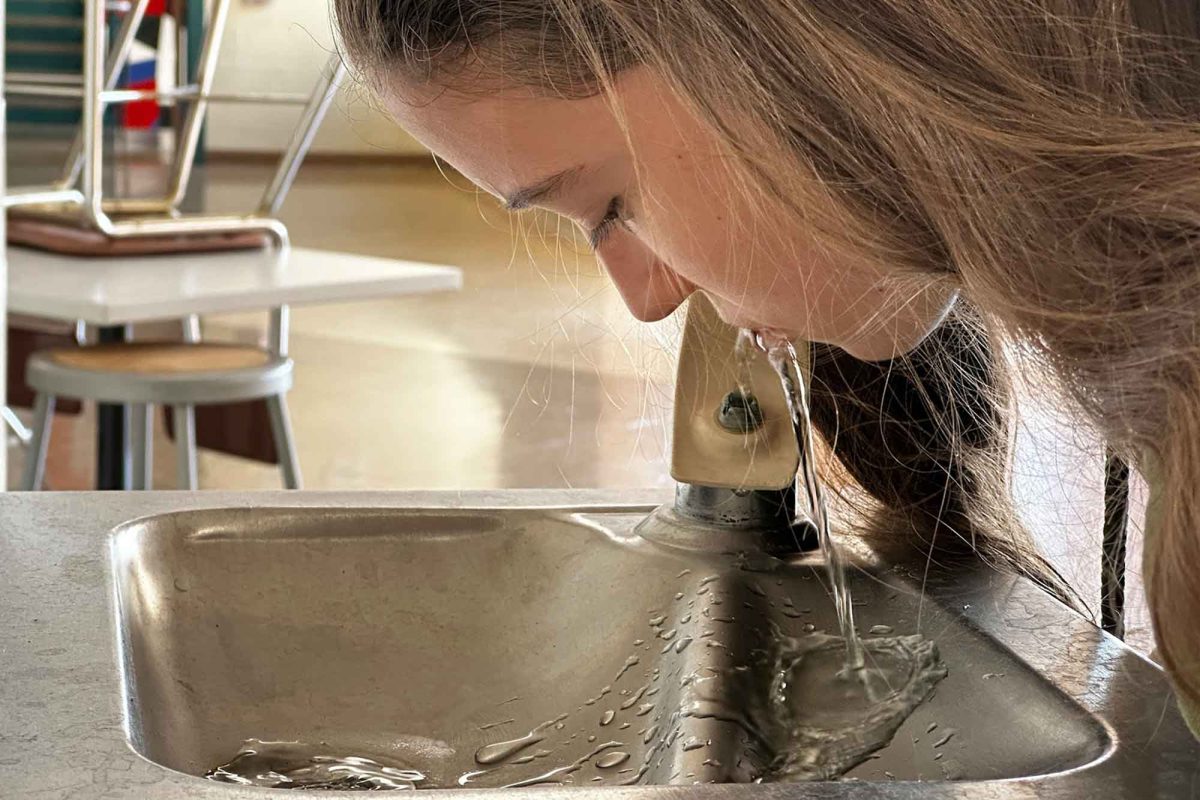
For over sixty years, mass fluoridation has provided Americans with fluoride in public water. In local tap water and the fountains at Haven, this mineral has been used to provide the public with important dental benefits, such as a reduction of tooth decay by 25%.
As a result, the Center for Disease Control has called fluoridation “one of the 10 great public health interventions of the 20th century.” However, these benefits may now be in jeopardy. Fluoride has faced significant controversy over the years, culminating in Health and Human Services Secretary Robert F. Kennedy Jr. advising that mass fluoridation of public water be halted, controversially labeling fluoride as “industrial waste.”
Fluoride is a mineral derived from the element fluorine.
“Fluorine is the ninth element on the periodic table, and it has seven valence electrons,” chemistry teacher Daniel Kahn said. “Most elements want to get eight valence electrons [to reach stability], so they gain or lose electrons in order to get there. So fluoride is what happens when fluorine gains that one more electron to get from seven to eight.”
Fluoride provides key dental benefits, such as helping to fight off cavities and preventing general tooth decay.
“The fluoride can disrupt the bacteria that are in our mouth. It’s called Streptococcus mutans…So the fluoride slows down how they work,” Kahn said. “Basically, the bacteria in your mouth are producing less [lactic] acid, which means that your teeth aren’t getting decayed by as much acid.”
Fluoride has even been shown to repair previous damage to teeth through a process called remineralization.
“Fluoride can actually help attract some of the ions back into your teeth,” Kahn said. “That [remineralization] helps your teeth get the solid coating that they need to be sturdy and healthy.”
One of the main places fluoride can be found is toothpaste, but public water is also a major source of fluoride.
Depending on the distribution of minerals, some water may come with natural amounts of fluoride, although these amounts can often be too small to actually attain benefits. In the 1960s, following an implementation in Grand Rapids, Michigan that saw dental benefits, the federal government began recommending that public water be fluoridated. Currently, 70% of all public water contains fluoride.
While the process can vary, fluoridation for Philadelphia’s water involves dissolving hexafluorosilicic acid (H₂SiF₆) into water.
“At the Philadelphia water department, they put some of this [fluorosilicic] acid into the water, and it breaks down in the water,” Kahn said. “It reacts with the water, and you get fluoride ions in the water, which are meant to protect your teeth. And you get a sort of stable, non reactive silicon compound that is also just hanging out in the water.”
Since its inception, fluoridation has been the subject of many controversies and conspiracy theories. One of the most prominent was a Cold War belief that it was a communist plot to chemically control the people.
Recently, Kennedy, as part of his “Make America Healthy Again” initiative has announced his intention to have the CDC no longer recommend mass public fluoridation, praising states like Utah, who he called for having banned it.
“I’m kind of confused about why he [Kennedy] is doing that and where his head’s at with that,” junior Jibrael Lakhoo said.
Scientists have disputed Kennedy’s claims, saying that they contradict the advice the CDC has given for years and accusing Kennedy’s claims of coming from misinformation. The key misconception that has led to significant debate about fluoride comes from the effects of using excessive amounts of fluoride rather than the amounts recommended by the government.
Some locations in the United States and across the world may have excessive amounts of naturally occurring fluoride, even above 1.5 milligrams per liter, due to geological phenomena such as fluoride rich rocks. The CDC recommends a fluoridation level limit of around 0.7 mg/L, and Wallingford, Media, and Haven’s water ranges from 0.12-0.38 mg/L, according to Aqua Water.
Kennedy has admitted that a ban on fluoride would likely result in “more cavities” but has asserted that the adverse dental effects would be worth it to balance out fluoride’s purported harms such as a correlation of excessive fluoride to lower IQs among children. While this link has some scientific backing, it isn’t the full story.
Adverse effects to IQ have only been found in areas where the natural fluoride minerals in the water go well beyond the government’s recommended limits for public fluoridation. When water fluoridation is at or below the recommended limits, there has been no conclusive evidence to suggest damage to IQ.
Dental fluorosis, a condition where too much fluoride causes white streaks on the teeth, potentially harming them, has likewise been reported to occur only with excessive fluoride usage beyond the amount the CDC advises in public water, as has the severely harmful bone disease skeletal fluorosis, which develops with prolonged excess fluoride and is rare in America.
Pennsylvania has a unique and less centralized approach to fluoridation, allowing individual municipalities to choose whether or not they use fluoride, as long as they stay within the advised range of 2.0 m/L or under. Swarthmore’s water, and that of other parts of Delaware County that comes from Crum Creek, does not contain fluoride.
“So it depends on where you are within our school district,” said school nurse Sarah Fleming.
Fluoride doesn’t need to come through only water or toothpaste though. Some countries in Europe such as Switzerland, Germany, and France take a completely different approach to getting fluoride to the public by putting fluoride into salt instead of water.
“So at the end of the day, it’s all fluoride. It’s just that F minus ion. When it’s in the water,” Kahn said. “You drink it, and that’s how it enters your body. When it’s in salt, you eat it, and it enters the water that’s in your body.”
Both approaches are aimed at better distributing fluoride to the given population, be it the more rural Switzerland or more urban America.
“I think just overall it’s more effective to have it in water because I feel like it’s more universal,” Lakhoo said.
Still, the effectiveness of fluoridation depends on whether or not students are drinking the fluoridated water.
“I think a lot of kids now drink bottled water anyway versus tap water,” Fleming said.
As a result, the water fountains at Haven may be one of the most direct and important ways for students to get fluoride.
“I think right now, in light of recent events, [it is important] to know that fluoride in your drinking water is perfectly safe,” Fleming said.