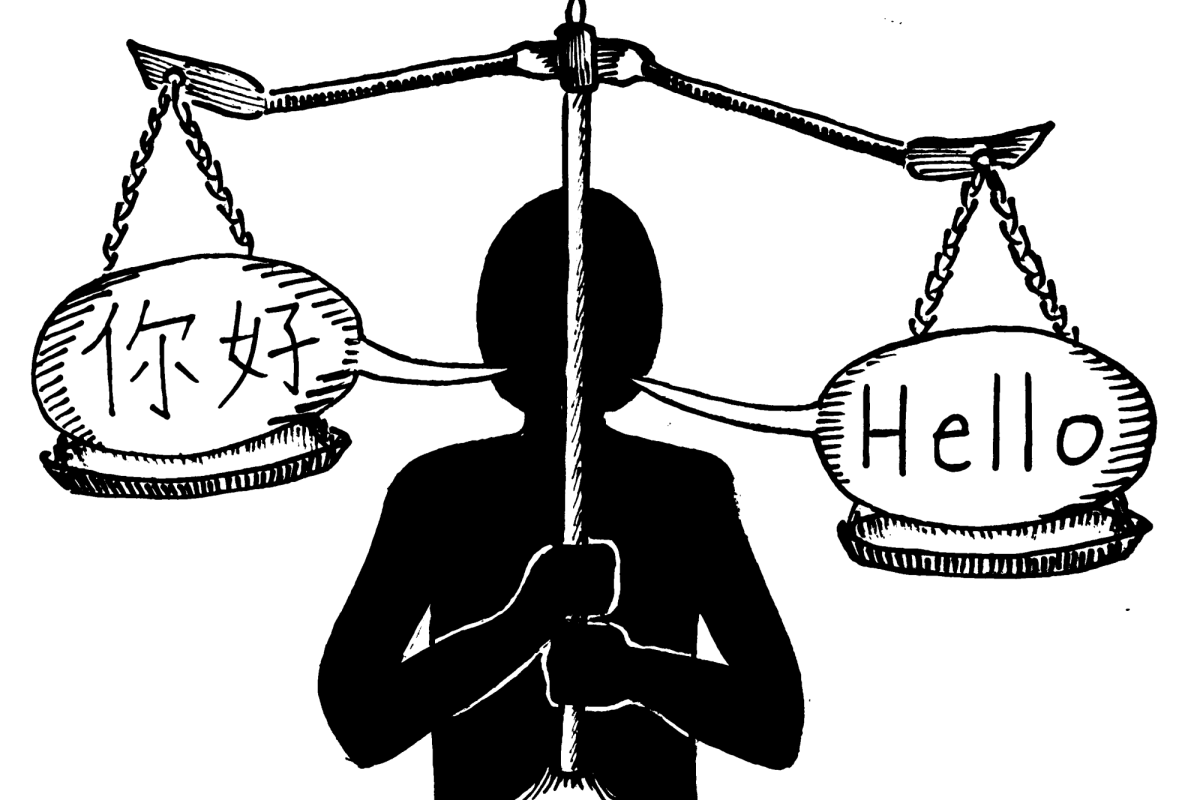
My mother was born and raised in Tianjin, China. She came to the U.S as a teenager, overwhelmed with the differences in American schools, pop culture, and struggling to fit in, all while tackling the beast of all beasts: English. Now, it’s the only language her daughter knows.
As a kid, I took Chinese classes every Sunday, but nothing ever really stuck. My mom never spoke Chinese at home, and I dreaded writing my characters over and over again as she scolded me for not being able to pronounce the tones correctly. As my hopes of fluency in Chinese faded further and further away, so did my connection with my culture and family. I mean, sure — I eat dumplings on Chinese New Year, but that’s pretty much it.
My relationship with my cultural identity all came to a head when my family and I traveled to China for the first time last summer. We visited the rural village where my extended family lived, and my grandma had grown up, but I couldn’t communicate with them, and my great uncles and aunts, who had been waiting for years to meet me, could only pinch at my cheeks while I muttered “Ni Hao,” over and over again.
Living in America in a predominantly white area, in a predominantly white school, with predominantly white friends, and a completely white father means I have little to no connection with my culture, and without language, without communication and words, I have nothing.
For multicultural kids growing up in America, being fluent in your family’s native language means everything.
Like my mom, senior Guixin Zhang moved to America from China her sophomore year. The Chinese language has helped her find community within Haven.
“I think it’s easier for me to make friends with people who know how to speak Chinese because we’ll have similar cultural experiences,” Zhang said. “Even if they’re American-born Chinese, they still live in a Chinese family, and they celebrate Chinese traditions. It’s hard to be really close friends with Americans, because of different cultures — we watch different dramas, and there’s much less common topics that we can talk about.”
Knowing your cultural language can help you connect with peers who might share similar experiences with you, who might understand what it’s like to grow up in an Asian family more than your white friends would. It’s important to be friends with people who are different from you, but having friends who share some of your experiences can be a cultural tether for teens growing up disconnected from their heritage.
Sophomore Daisy Sanchez was born in America. She and her siblings grew up learning Spanish and English at the same time. Unlike Zhang, Sanchez notices a lack of Hispanic peers at Haven, however her fluency in Spanish allows her to find community outside of school.
“Especially at this school, I haven’t really met any Hispanic people. It’s sometimes rare to speak to people my age in Spanish,” Sanchez said. “With my family, we got lucky enough to live near a Cuban family. We have dinners with them, and that’s honestly, really amazing because they’re the only people in our neighborhood who speak Spanish.”
Even if your parents didn’t raise you in their language, if it’s important to you, it’s never too late to learn something new. Studies show that learning languages increases intelligence.
Half-Greek sophomore Efthalia Reo takes Greek language lessons twice a week to stay up to date. If remaining connected to your culture matters to you, all you need to do is put in the effort.
While language is an effective way to develop your cultural identity in America, if you’re like me and that ship has sailed, don’t be discouraged.
There are plenty of ways to get involved with the cultural community around you. At times, it may seem scarce, but opportunities are hiding in plain sight. I feel closer to my culture by simply accompanying my mom to the Asian market on weekends to buy ingredients for dinner. Little things like buying red envelopes for each other on holidays make all the difference.
“I go to St. George’s Orthodox Church, and there is a big Greek community there, where there’s Greek dancing and a lot of Easter traditions. So yeah, there’s definitely a community around here,” Reo said.
So, as a PSA to all the mixed kids who don’t know their parents’ language, have completely adopted American culture, and maybe don’t enjoy their cultural food as much as they should: you don’t have to feel guilty, and you aren’t alone.
However, I do encourage you to prioritize learning your language as much as you can, even if it’s too late for fluency. Try learning a few phrases that’ll impress your grandparents, try humming a song in a different language while you’re washing dishes or folding clothes — it makes all the difference.
“If you’re in an area where you can’t really show your kids their culture as much as you would like, giving them that base of knowing their language is really good for them,” Sanchez said.
Each opinion represented in The Panther Press is the view and voice of the writer. Opinions, as the selection and curation of content by the editors, do not represent the views of the entire Panther Press staff, the adviser, the school, or the administration.