When seasons change, so does temperature, sunlight, and even mood. These changes throughout different parts of the year can lead to seasonal affective disorder (or SAD).
Seasonal affective disorder (commonly known as seasonal depression) is a diagnostic form of depression. It’s ‘seasonal’ due to the fact that when people experience it, it’s only for a portion of the year.
Behavioral counselor Ms. Kate Sargent explains that SAD can be present at any time in the year.
“It is a type of depression that comes up in people when the seasons change, and it’s more typically around the fall and winter time, due to the lack of sunlight and due to the colder weather, a lot of people experience it, but also can happen any other season,” Sargent said.
Seasonal affective disorder can be traced back to the chemicals serotonin and melatonin, which are extremely different to the human body. Serotonin is a hormone that makes people feel energetic and happy. On the other hand, melatonin is produced to help the body calm down and sleep, in addition to playing a major role in regulating the body’s circadian rhythms, which is an internal clock that functions telling people when to feel awake and when to be sleepy.
According to the National Institute of Mental Health, seasonal affective disorder happens because the levels of these chemicals change due to changes in sunlight as seasons shift. When people get less sunlight in the winter, their body’s produce less chemical serotonin and produce an increased amount of chemical melatonin. This can make people feel more negative emotions, as well as making them feel more tired and sleepy.
In contrast, an increase in sunlight near the summertime results in lower melatonin levels, which could cause sleep disruption although no official testing has been done on this.
Simply put, the change in levels of serotonin and melatonin during different seasons can impact people differently. Seasonal affective disorder can come with many different symptoms that vary from person to person.
Ninth grade counselor Mr. Gavin Stewart lists some of the possible symptoms that can be present in people with seasonal affective disorder.
“Symptoms that you might see can look like fatigue, overly tired, a change in appetite, a loss of energy, a difficulty in just doing day to day things, and it comes with negative thoughts,” Stewart said.
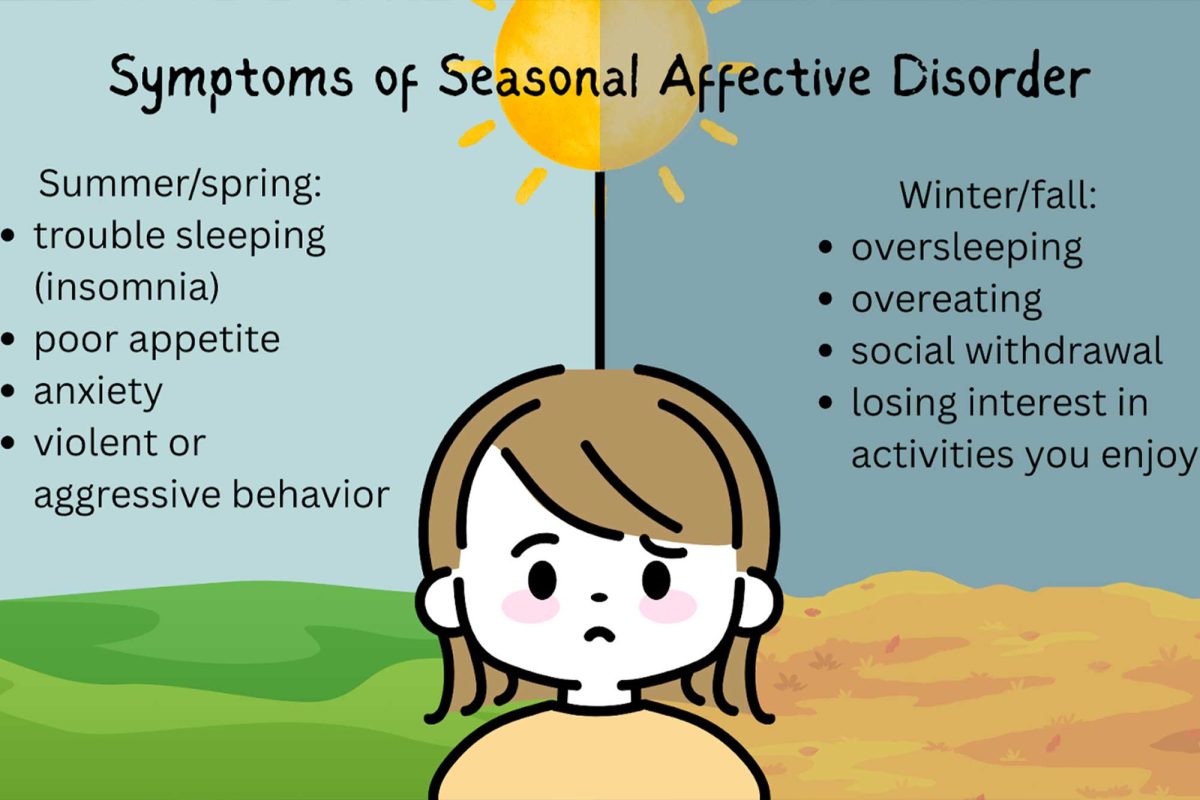
During different seasons, people with SAD can encounter different symptoms. Symptoms of SAD that people experience in the summer/spring can include trouble sleeping, having a poor appetite, anxiety, or displaying violent or aggressive behavior.
In the winter/fall, symptoms of SAD include overeating, oversleeping, social withdrawal, and a loss of interest in activities that people usually enjoy.
As people cope with SAD, they can experience the challenges and effects of the disorder firsthand. Stewart explains the impact that SAD can make on students’ school lives.
“There’s a lot of different context for people’s lives, and people struggle with different things…It might be harder to do the executive functioning tasks of keeping track of your homework, harder to do projects, but it could affect anybody in a different way,” Stewart said.
In addition to influencing students at school, school psychologist Mr. Christopher Bennett offers a further insight, describing how SAD can impact a person’s social interactions and mood overall.
“It can affect your mood. It can affect your concentration, your focus. You can be a lot more sleepy during the same time. So that affects a lot of things, and it can affect your relationships with other people, if you are a lot more irritable and short with people,” Bennett said.
SAD is a medical condition that is clinically diagnosed. People who think they might have SAD can be diagnosed officially by a professional clinician who refers to the DSM-5, which is a book that contains the specific requirements for mental health diagnoses.
“In order to be diagnosed, you would have to go to a professional clinician, which is typically a therapist or a primary care physician, but you’re able to be diagnosed through a mental health professional,” Sargent said.
Even though SAD can be challenging for patients, there are strategies that people who are diagnosed with SAD use, and that anyone can use who feels downcast at times.
“There’s a lot of little things that can be really helpful to make you feel better, like trying to get sun. There’s barely any sun outside, and I know that’s can be very difficult…Try to move your body, exercising. Moving our body provides a lot of serotonin in our brains, and dopamine as well. So that can kind of help you increase happiness [and] feeling comfortable talking to friends,” Sargent said.
Sargent emphasizes the importance of asking for help, because no one should struggle alone. SAD is a medical condition that should be met with proper care.
“If you are having some serious concerns regarding your mood and just behaviors and seasonal affective disorder in general, reach out to a trusted clinician,” Sargent said. “Maybe if you have a therapist or doctor or trusted adult, like a parent, guardian, teacher, and kind of express those concerns, and then other school staff or family members or things like that can help you kind of figure it out.”