
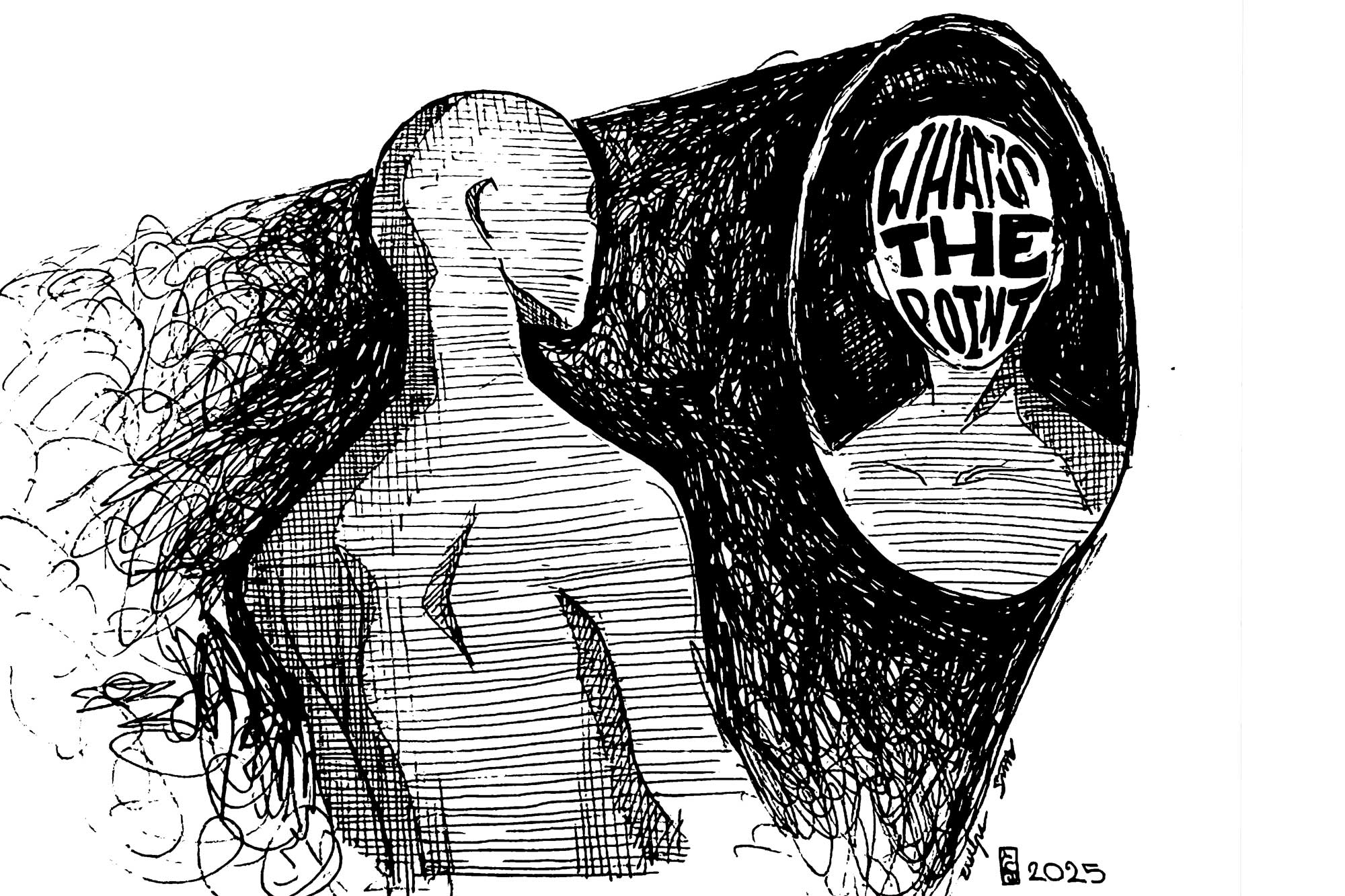
In America right now, it can feel like we’re teetering on the brink of chaos. Some people would say that we already are in that chaos. This perceived lack of order is starting to be felt by teens, not only politically, but also in how they live their lives.
Nihilism is a 19th century term which boils down to the belief that life is without meaning, pointless. In practice, this often leads to a purposeless, passionless person. If life has no point, why should they?
English teacher Matthew Wood has seen an increase in passionless students in recent years, observing that more and more students don’t seem to have purpose, or even an interest in their life.
“You have to be interested in your own life, no one can make your life interesting for you,” Wood said. “No one’s going to save you…You have to have purpose in your own life. It may be a struggle to find it, but that’s a purpose in and of itself.”
But why is this happening now? Most teachers agreed that it was a result of many different things, one of which was the COVID lockdown.
“I think the trend began around 10 years ago, the major [factors had started], and then the disruption to school that was the COVID lockdown became an accelerant to that,” social studies teacher TJ Adams said.
Social studies teacher Richard Foulk agreed with the idea that students are different now than they were in the past, such as the time they take to do tasks. He chalks it up to screens.
“It’s electronic distraction and shortened attention span,” Foulk said. “I wouldn’t say just phones, I’d say the things that are out there in the world allow you to not focus. It’s the instant gratification of the internet.”
Wood sees the internet as a cause of the nihilism not because of the shortened attention spans, but because of the content that the students are viewing on social media.
“There’s a perceived lack of possibility,” Wood said. “‘Well, AI is going to take all the jobs.’ ‘I can’t afford to go to college and take on that debt.’ I could go on and on with things we hear about in culture through the media about doom and gloom. “
The internet is a vehicle for information, and he fears that it will, ironically enough, close people off from other viewpoints.
“We get bombarded with these messages that the world is falling apart, particularly if we seek them out,” Wood said. “If kids today are looking for confirmation that the world sucks, they can find it very easily. You can find that echo chamber of the world’s not fair, the world sucks. What’s the point? Why try?”
This isn’t only being seen at Haven. According to one study, over 50 percent of young people think that humanity is doomed, which leads to feelings of nihilism. If there’s nothing that can be done, then what’s the point in trying?
If this societal trend is allowed to continue, it could have major consequences for our society, but more importantly for individuals.
Adams worries that the rise in nihilism could diminish the ability to connect and have relationships with others.
“It feels like, in some ways, an unwinding of what we were building for the last 100 years, which was a way of life that acknowledges individuals and tries to develop and cultivate what is unique about people in ways that make their lives meaningful,” Adams said.
To help turn the tides on this mentality shift, Wood believes that one path could be through SEL (social emotional learning), which is a topic that administration has introduced in recent years. He thinks that it is important to talk about mental health with the students, to help them believe in their future.
However, Wood acknowledges challenges for schools in developing systems to implement SEL successfully, especially since it’s taught by general education teachers.
“I wasn’t trained to do that stuff,” Wood said. “I wasn’t trained in psychology. I wasn’t trained in social emotional learning. I’m a Gen Xer. I’m 55 years old. I can teach you English and how to write literature and the value of it, but there’s a big chasm between me and my 10th grade students currently, and even my seniors.”
As for Adams, he sees the trend towards nihilism more as a mindset. He thinks that it can be fixed by re-prioritizing our school’s values, placing emphasis on humanities and art — especially considering Haven has a reputation of academic pressure.
“I’d like to see us place less emphasis on high school as a path to some career goal,” Adams said. “I’d like to see us turn down the intense focus on what colleges we’re getting into and having school being directed towards that. I’d like to see us place a greater emphasis on the humanities and the arts, because I think that’s where young people can do the work of self building.”
Maybe the answer lies in the humanities, where teachers can help students find meaning through literature.
“Math and science are wonderful things important for human progress and societal technological development,” Adams said. “I don’t mean to diminish them, but we don’t learn about ourselves, and we don’t develop our inner lives, and we don’t develop our passions by finding ‘x’. We do it through reading literature, through making art, and experiencing art, through reading about history and how others have gotten on with their lives and found meaning.”
Each opinion represented in The Panther Press is the view and voice of the writer. Opinions, as the selection and curation of content by the editors, do not represent the views of the entire Panther Press staff, the adviser, the school, or the administration.